News
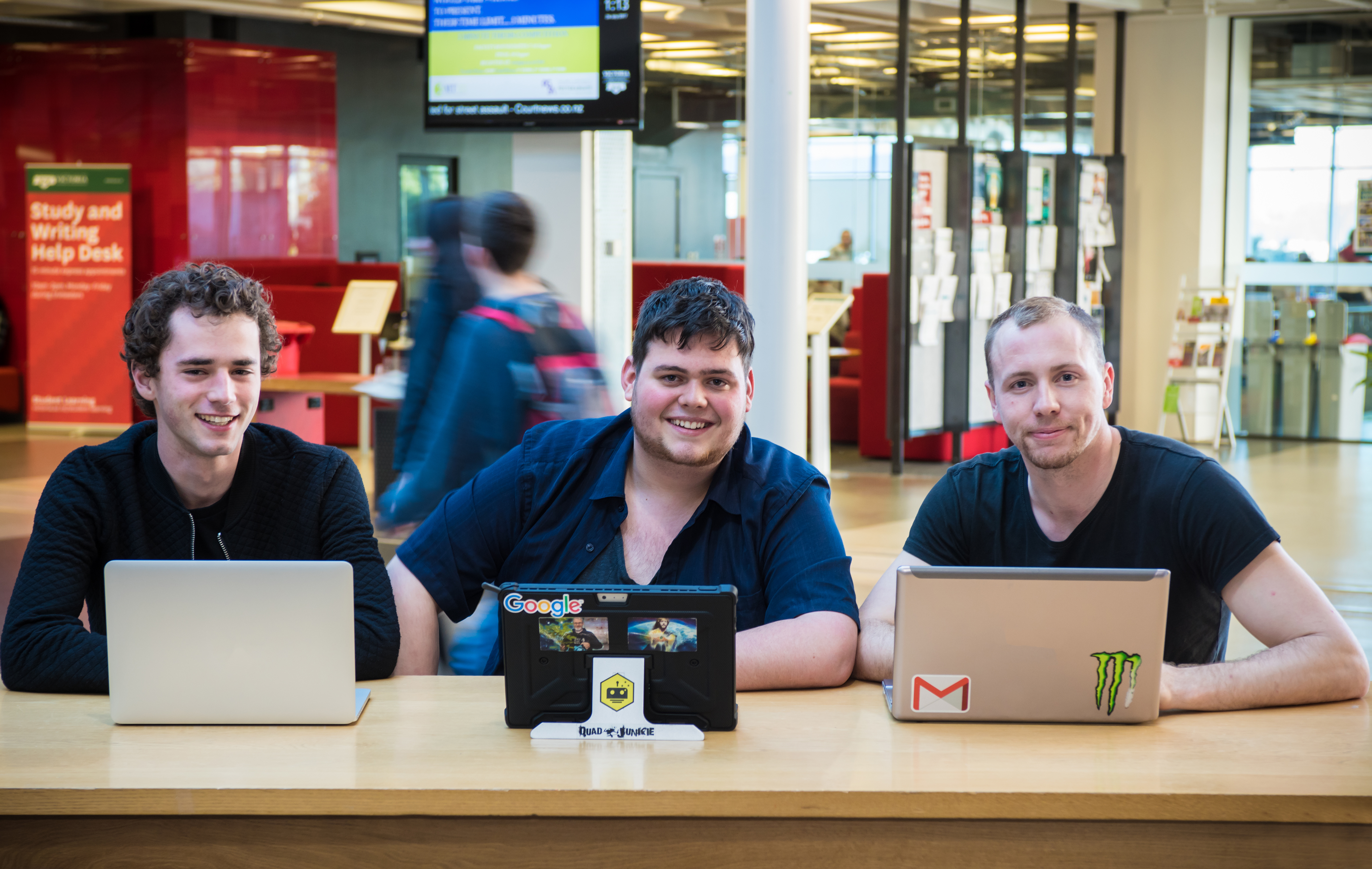
Victoria students compete at New Zealand Cyber Security Challenge
02 Aug 2017 - 08:18
Digital Disruption: A Wellington Case Study
20 Sep 2016 - 11:46
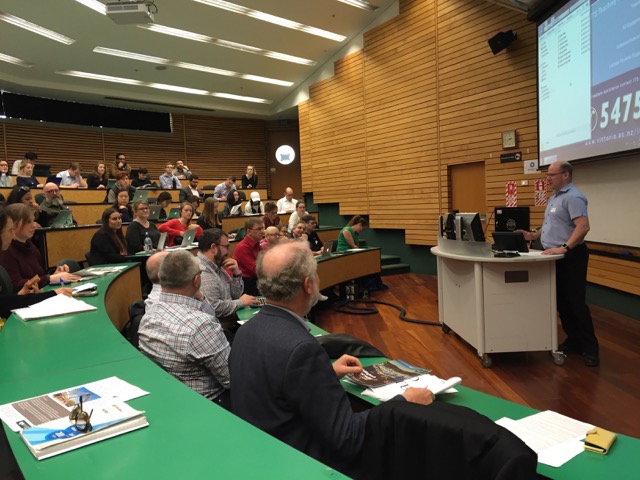 The challenges facing Wellington's fast-growing digital industry were explored in a recent seminar hosted by Victoria University.
 The event, titled "Digital Disruption: A Wellington Case Study", brought together staff and students from Victoria's Schools of Engineering and Computer Science, and Management, with industry experts and practitioners, who delved into what it takes to thrive in the digital age.
Dr Richard Norman, a co-host of the event, is a senior lecturer in Victoria's School of Management. His research focuses on understanding how people and organisations can adapt to technology change.
"The work environment is changing. Occupations are changing, there are new sectors emerging—such as the cyber security sector—and companies are becoming more agile, with a focus on fast development and fast turnaround", says Dr Norman.
"What is distinctive about this event is that it brought together both the people and the technical sides of business. For companies to be successful they really have to be on top of both. We have had a lot of interest in this event from the local digital industry—it's a good opportunity to share knowledge".
Dr Stuart Marshall, Head of Victoria's School of Engineering and Computer Science, says that the event gave students an important opportunity to hear about the industry many of them will be working in.
"We ran a similar event late last year, which was solely for industry. This year we wanted to open it up to students, so we ran it during class time to make it even more accessible. When students graduate a lot of them will be working in these digitally-focussed companies, and this was a valuable opportunity to hear about what the environment is like".
This year, the speakers were:
- Associate Professor Kris Bubendorfer, Victoria University of Wellington
- Professor Neil Dodgson, Victoria University of Wellington
- Collier Isaacs, Farm IQ
- Ruth McDavitt, Summer of Tech
- Dean Pemberton, Network Startup Resource Center
- Anthony Pratt, Park Road Post Production
- Laura Reitel, Lightning Lab / Creative HG
- Chris Ward, Total Risk / CyberToa
- Dr Ian Welch, Victoria University of Wellington
Cyber security short courses for professionals
04 May 2016 - 09:10
 Victoria University of Wellington is offering Software Engineering Institute (SEI) certified cyber security courses in New Zealand for the first time.
Cyber security is seen as one of the greatest commercial threats to New Zealand. With the increasing imperatives for New Zealand business and government to be protecting themselves in the cyber space, the short courses will provide specialised training opportunities.
The courses are run at Victoria’s Centre for Lifelong Learning, in partnership with Total Risk Management.
Total Risk Management has recently become Asia-Pacific’s only Carnegie Mellon University SEI Partner—one of only nine partners worldwide in the last 30 years.
The SEI is a not-for-profit Federally Funded Research and Development Centre at Carnegie Mellon University, specifically established by the United States Department of Defense to focus on software engineering and cybersecurity.
SEI courses are the recognised industry standard for the best continuing education and credentialing for engineering and software professionals in government, industry and higher education.
The courses at Victoria range from one to five days, and are crucial professional development for anyone from CEOs and CIOs wanting to understand the cyber security risks around information, through to IT professionals managing and dealing with cyber security incidents.
Offered in Wellington and Auckland, and run in-house for organisations, the five key courses cover assessing information security risks, overview of incident response teams, creating and managing incident response teams, and incident handling.
The full course outline, registration details and dates can be found online at http://ped.victoria.ac.nz/course-catalogue/27-cyber-security
Victoria University of Wellington is offering Software Engineering Institute (SEI) certified cyber security courses in New Zealand for the first time.
Cyber security is seen as one of the greatest commercial threats to New Zealand. With the increasing imperatives for New Zealand business and government to be protecting themselves in the cyber space, the short courses will provide specialised training opportunities.
The courses are run at Victoria’s Centre for Lifelong Learning, in partnership with Total Risk Management.
Total Risk Management has recently become Asia-Pacific’s only Carnegie Mellon University SEI Partner—one of only nine partners worldwide in the last 30 years.
The SEI is a not-for-profit Federally Funded Research and Development Centre at Carnegie Mellon University, specifically established by the United States Department of Defense to focus on software engineering and cybersecurity.
SEI courses are the recognised industry standard for the best continuing education and credentialing for engineering and software professionals in government, industry and higher education.
The courses at Victoria range from one to five days, and are crucial professional development for anyone from CEOs and CIOs wanting to understand the cyber security risks around information, through to IT professionals managing and dealing with cyber security incidents.
Offered in Wellington and Auckland, and run in-house for organisations, the five key courses cover assessing information security risks, overview of incident response teams, creating and managing incident response teams, and incident handling.
The full course outline, registration details and dates can be found online at http://ped.victoria.ac.nz/course-catalogue/27-cyber-security
Putting cybersecurity centre stage
09 Dec 2015 - 10:44
 Victoria University of Wellington is kick-starting initiatives for championing cybersecurity in New Zealand with an industry briefing featuring a guest appearance from a world-renowned cyber-crime expert.
Cybersecurity is seen as one of the greatest commercial threats to New Zealand. The Wellington event aims to raise awareness of the developing risks in the digital world and the costs of complacency, and will be attended by senior representatives from some of New Zealand’s largest companies.
Joining the briefing will be Kristopher Rush, a technical director in the Computer Emergency Response Team (CERT) division of the Software Engineering Institute (SEI) in the United States, and a leading expert in cybersecurity.
Before joining SEI, Mr Rush worked for the United States Department of State as a member of the Antiterrorism Assistance Program, where he developed and taught courses relating to terrorism and cyber-crime to foreign military and police.
His visit follows the announcement of a collaboration agreement between Victoria University, SEI and the New Zealand firm Total Risk to develop training, advice and protection services in cybersecurity.
“Most New Zealand businesses and many government agencies are lacking the individual expertise to protect themselves from the growing cyber danger,” says Geoff Todd, Managing Director of Viclink, the University’s commercialisation office.
“By arranging the industry briefing and bringing Kristopher over to New Zealand, we want to place cybersecurity front and centre in the minds of industry, and profile what we intend to do in this space to help.
“The collaboration with SEI means we will be working with the gold-standard organisation in the field of cybersecurity, and the relationship with Total Risk means we are aligned with one of only nine SEI certified training partners in the world, and the only one in New Zealand.
“Through this collaboration we aspire to be a leader in cybersecurity in the Asia-Pacific region,” says Geoff.
The SEI is a Federally Funded Research and Development Centre (FFRDC) at Carnegie Mellon University, specifically established by the United States Department of Defense to focus on software engineering and cybersecurity.
Victoria University of Wellington is kick-starting initiatives for championing cybersecurity in New Zealand with an industry briefing featuring a guest appearance from a world-renowned cyber-crime expert.
Cybersecurity is seen as one of the greatest commercial threats to New Zealand. The Wellington event aims to raise awareness of the developing risks in the digital world and the costs of complacency, and will be attended by senior representatives from some of New Zealand’s largest companies.
Joining the briefing will be Kristopher Rush, a technical director in the Computer Emergency Response Team (CERT) division of the Software Engineering Institute (SEI) in the United States, and a leading expert in cybersecurity.
Before joining SEI, Mr Rush worked for the United States Department of State as a member of the Antiterrorism Assistance Program, where he developed and taught courses relating to terrorism and cyber-crime to foreign military and police.
His visit follows the announcement of a collaboration agreement between Victoria University, SEI and the New Zealand firm Total Risk to develop training, advice and protection services in cybersecurity.
“Most New Zealand businesses and many government agencies are lacking the individual expertise to protect themselves from the growing cyber danger,” says Geoff Todd, Managing Director of Viclink, the University’s commercialisation office.
“By arranging the industry briefing and bringing Kristopher over to New Zealand, we want to place cybersecurity front and centre in the minds of industry, and profile what we intend to do in this space to help.
“The collaboration with SEI means we will be working with the gold-standard organisation in the field of cybersecurity, and the relationship with Total Risk means we are aligned with one of only nine SEI certified training partners in the world, and the only one in New Zealand.
“Through this collaboration we aspire to be a leader in cybersecurity in the Asia-Pacific region,” says Geoff.
The SEI is a Federally Funded Research and Development Centre (FFRDC) at Carnegie Mellon University, specifically established by the United States Department of Defense to focus on software engineering and cybersecurity.
First Year autonomous robot challenge
29 Jun 2015 - 11:29
Many Engineering students want to get ‘hands-on’ with their course work as quickly as possible—after all, they’re often practical people who like to learn through doing. So when Victoria University’s first-year Engineering students discover they’ll be building an autonomous vehicle during their first trimester , most can’t believe their luck!
“The first part of Engineering 101 (ENGR101) gives students a general introduction to engineering practice, and covers the basics of software, hardware and network systems,” says Dr Stuart Marshall, Head of the School of Engineering and Computer Science. “Halfway through the first trimester, we form them into teams so they can apply this knowledge to complete a project – the Autonomous Vehicle Challenge – which includes all aspects of these technologies.”
Dr Marshall says that each team of students must build a vehicle – complete with processing board, motor driver, and a network link to communicate its progress back to a central computer – which can navigate its way through four quadrants of a maze, each more difficult than the last. Students fit sensors to their hand-sized vehicles to keep them on the right path, and away from walls and other obstacles.
“We change the maze every year, just to keep things interesting,” says Dr Marshall. “This year, we’ve added an archway with an automated door that opens and closes; students now have the added challenge of having to get the timing right in order to pass their vehicles through the archway unobstructed.”
At the end of the first trimester, vehicles are put to the test; each team must race their vehicle against the clock while attempting to complete all four quadrants. The top performing vehicles take part in a final, more informal, challenge where they compete for bragging rights rather than credits.
“You could say that we’re throwing students in the deep end,” says Dr Marshall. “But the project not only provides an effective way for students to engage in the many aspects of engineering, it also gives them a tangible way of learning how to problem-solve. And they seem to really enjoy it!”
Dr Marshall says that in addition to team work, each student has to write an individual report, reflecting on what worked and what didn’t work during the process. “Students obviously develop practical skills while they’re building their vehicles, but they’re also learning soft skills such as report-writing, time management, and how to work as part of a team.”
Some previous ENGR101 students have cited their experience with the Autonomous Vehicle Challenge as the event that got them interested in the National Instruments Autonomous Robotics Competition (NI-ARC) – a student robotics competition designed to encourage development and innovation in the field of robotics.
Offline but switched on
19 Jun 2015 - 11:21
 Computer Science workshop to inspire new way of teaching
“Computer Science is no more about computers than astronomy is about telescopes”
- Edsger Dijkstra, Dutch computer scientist
Invitation:
Victoria University of Wellington invites primary teachers to a free workshop which aims to change the way computer science is taught to primary school students.
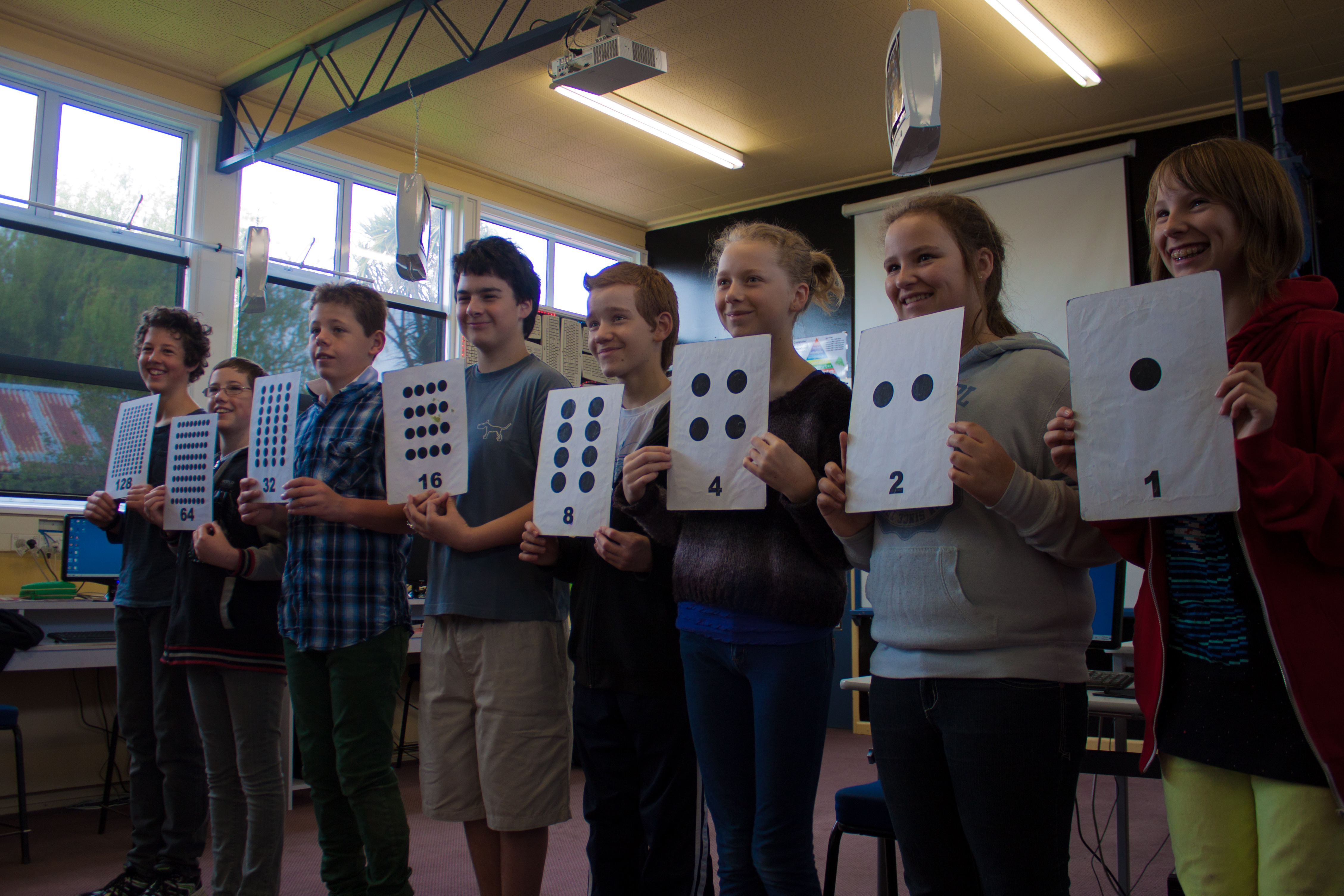
Computer Science Unplugged (CSU) is a collection of kinesthetic learning activities that teach computer science through games and puzzles using hands-on materials, and enable young students to physically engage with concepts – without a computer in sight!
The two-hour programme will enlighten teachers as to the benefits of CSU, and will be of value to those primary and intermediate teachers interested in adopting computational thinking in the classroom and encouraging young minds to explore the dynamic world of computer science.
“CSU is about empowering students to explore the great ideas that are hidden in the technologies that have become so commonplace that they are taken for granted,” says workshop coordinator Professor Tim Bell from the University of Canterbury.
“This removes the barrier of having to learn to program or even own a computer before you find out if computer science is really your thing.”
CSU introduces students to underlying concepts such as binary numbers, algorithms and data compression, but remain separated from the distractions and technical know-how we usually associate with computers.
These teaching methods have become widespread in countries such as Sweden, Germany, Korea and Japan, with the CSU programme itself supported internationally with online and adaptable resources.
Event details
Computer Science Unplugged
Thursday 9th July 2015, 9.30am-11.30am
Top floor of the Lower Hutt War Memorial Library, Corner Queens Drive and Woburn Rd.
Places are limited so please RSVP to suzan.hall@vuw.ac.nz at your earliest convenience.
Further information about Computer Science Unplugged, including resources and texts for teachers, can be found online at http://csunplugged.org
Computer Science workshop to inspire new way of teaching
“Computer Science is no more about computers than astronomy is about telescopes”
- Edsger Dijkstra, Dutch computer scientist
Invitation:
Victoria University of Wellington invites primary teachers to a free workshop which aims to change the way computer science is taught to primary school students.
Computer Science Unplugged (CSU) is a collection of kinesthetic learning activities that teach computer science through games and puzzles using hands-on materials, and enable young students to physically engage with concepts – without a computer in sight!
The two-hour programme will enlighten teachers as to the benefits of CSU, and will be of value to those primary and intermediate teachers interested in adopting computational thinking in the classroom and encouraging young minds to explore the dynamic world of computer science.
“CSU is about empowering students to explore the great ideas that are hidden in the technologies that have become so commonplace that they are taken for granted,” says workshop coordinator Professor Tim Bell from the University of Canterbury.
“This removes the barrier of having to learn to program or even own a computer before you find out if computer science is really your thing.”
CSU introduces students to underlying concepts such as binary numbers, algorithms and data compression, but remain separated from the distractions and technical know-how we usually associate with computers.
These teaching methods have become widespread in countries such as Sweden, Germany, Korea and Japan, with the CSU programme itself supported internationally with online and adaptable resources.
Event details
Computer Science Unplugged
Thursday 9th July 2015, 9.30am-11.30am
Top floor of the Lower Hutt War Memorial Library, Corner Queens Drive and Woburn Rd.
Places are limited so please RSVP to suzan.hall@vuw.ac.nz at your earliest convenience.
Further information about Computer Science Unplugged, including resources and texts for teachers, can be found online at http://csunplugged.org
The Anita Borg Memorial Scholarship
03 Apr 2015 - 00:25
The Google Anita Borg Memorial Scholarship is open for applications with a deadline of 27th May 2015.
Anita Borg believed that technology affects all aspects of our economic, political, social and personal lives. In her life she fought tirelessly to ensure that technology’s impact would be a positive one. It was this vision that inspired Anita in 1997 to found the Institute for Women and Technology. Today this organization continues on her legacy and bears her name, The Anita Borg Institute for Women and Technology.
Dr. Anita Borg proposed the "50/50 by 2020" initiative, an effort to increase the percentage of women among graduates earning computing degrees to 50% by the year 2020. However, the percentage of Computer Science degrees earned by women is still far from 50% throughout the world.
Through the Anita Borg Memorial Scholarship for Asia Pacific, Google aims to encourage women to excel in computing and technology, and become active role models and leaders in these fields.
To be eligible to apply, applicants must:
- Be a female student enrolled in undergraduate or postgraduate study in the 2016 academic year.
- Be enrolled in a university in Asia Pacific. Citizens, permanent residents, and international students are eligible to apply.
- Be majoring in computer science, computer engineering, or a closely related technical field.
- Exemplify leadership and demonstrate passion for increasing the involvement of women in computer science.
Launch of the TechHub CREST Challenge
06 Mar 2015 - 10:57
Year 10 students at St Mary's College were captivated by visiting speakers at a special assembly to launch the TechHub CREST Challenge to develop a phone app. St Mary’s students have started their journey into the arena of software development, highly motivated by words of encouragement from Tasha Sharp who is based at the Institute of IT Professionals, and four senior Victoria University students.
Elf Eldridge, a senior tutor from the School of Engineering and Computer Science, brought along four students who are studying either software engineering or networking. They provided an insight into the potential of pursuing a career in IT and also the opportunities for work at Google. Konnie and Kate who are Google ambassadors, and Bonnie and Ellie shared their passion for software development and programming.
Year 10 students reflected on the presentation:
Konnie and Kate made Google sound like a great work place, and a fun environment to be in. Bonnie and Ellie explained to us the sort of studies they do in university, and it sounded very interesting – Amelia.
Konnie and Kate taught me a lot about the Google lifestyle and environment, I absolutely agree that more women should be involved with technology as the world is beginning to have more and more technology – Kennedy.
Bonnie and Ellie talked about how they created programs and robots and cool things like that. They told us that even if you don't have a lot of knowledge about programming it’s alright because you will learn more and gain more knowledge. I think that doing this project will be fun and a lot of hard work and I'm also excited to see how it all works out at the end – Amour.
I'm looking forward to starting this project because it’s a new experience and seems like a fun challenge for me. I don't know what to expect because this is new to me but I’m keen for it and can’t wait to get stuck in – Lizzie.
There are a lot of apps on my phone so it would be really amazing to see how they are made. It is also very exciting because we will be working in groups so we will have to work together on this and use our skills to build an app – Sophie.
Thank you to Mrs Genevieve Herder, Digital Technologies, St Mary's College, for this article.
Lecture to highlight Alan Turing's genius
19 Feb 2015 - 14:23
The School of Engineering and Computer Science is hosting a lecture about the work of Alan Turing, often dubbed the father of modern computing and the subject of the film The Imitation Game.
Professor Rod Downey from the School of Mathematics, Statistics and Operations Research at Victoria will deliver the public lecture in which he aims to give an accurate picture of Turing’s work and his place in history.
Professor Downey has spent the last 35 years researching in the area of the theory of computation and recently edited the book Turing’s Legacy: Developments from Turing’s Ideas in Logic.
Alan Turing was a mathematician and logician whose ideas led to the development of the modern computer and artificial intelligence. He has recently come to popular attention through The Imitation Game which focuses on his role in cracking intercepted coded messages in Britain during the Second World War.
Professor Downey says the film “horribly mangles” Turing’s contribution, and the nature of Bletchley Park, the central site of the United Kingdom’s Government Code and Cypher School which was a key hub for penetrating communications during the Second World War.
Professor Downey describes Turing as one of the geniuses of the twentieth century.
While Professor Downey will spend a small part of his lecture discussing things the film got wrong, most of his address will focus on mathematics, especially the development of computers and how cryptanalysis worked at Bletchley Park. He will pay particular attention to covering the range and variety of Turing’s work and the impact it has had.
“Turing was a prodigy, a brilliant and original man who was terribly treated for being gay. His story is a study in ideas and social commentary.”
In his lecture, Professor Downey will cover a brief history of ciphers, the work done by the cryptanalysts at Bletchley Park and how the Enigma machine works, all of which are portrayed in The Imitation Game.
Professor Downey will also discuss some of Turing’s less known work in areas including Biology.
What: Public Lecture: Alan Turing, Computing, Bletchley and Mathematics
When: Thursday 26 February, 5.30pm
Where: Government Buildings, Lecture Theatre 2
RSVP: Siyun.thompson@ecs.vuw.ac.nz
This public lecture is the first in a series of events being run by Victoria’s School of Engineering and Computer Science with the aim of making science more accessible.
Rod Downey, FRSNZ, is a professor of mathematics at Victoria University of Wellington. His research is in the theory of computation and complexity theory. He is the only person in New Zealand who both is a Fellow of the Association for Computing Machinery and the American Mathematical Society. During the Alan Turing year (2012 – centenary of Alan Turing’s birth) he was one of the foundation fellows at the Isaac Newton Institute at Cambridge for the Alan Turing Programme. He recently edited the volume Turing's Legacy for the Association for Symbolic Logic. He has won numerous awards for his work including a James Cook and Maclaurin Fellowship, the Shoenfield Prize from the ASL, and the Nerode Prize from the EATCS.
For more information contact Professor Rod Downey on 04-463 5067, or rod.downey@vuw.ac.nz
New Students' Orientation
13 Feb 2015 - 21:40
The School of Engineering and Computer Science welcomes all new students.
We recommend that you attend the new students’ orientation from the 23 - 27 February. For further details check out: http://www.victoria.ac.nz/students/new-students/orientation
On Thursday 26 February all new engineering and computer science students are invited to a welcome session in lecture theatre 101 in the Maclaurin building. Meet staff who teach in first-year courses and find out how to get the most out of your lectures, tutorial and labs.
Engineering students will also get to know their fellow students with a fun team exercise followed by a BBQ at 5pm.
This topic: Main > NewsArchive
Topic revision: 23 Mar 2026, christo
Topic revision: 23 Mar 2026, christo