
Modern machine learning increasingly operates in environments where data arrives over time and conditions evolve. Rather than learning once from a fixed dataset, systems must continuously update, adapt, and remain reliable under changing distributions. This setting can be broadly described as machine learning over time under changing data.
Different assumptions about how data arrives and how knowledge should be retained lead to distinct learning paradigms. Below, we outline the main ones and how they relate.
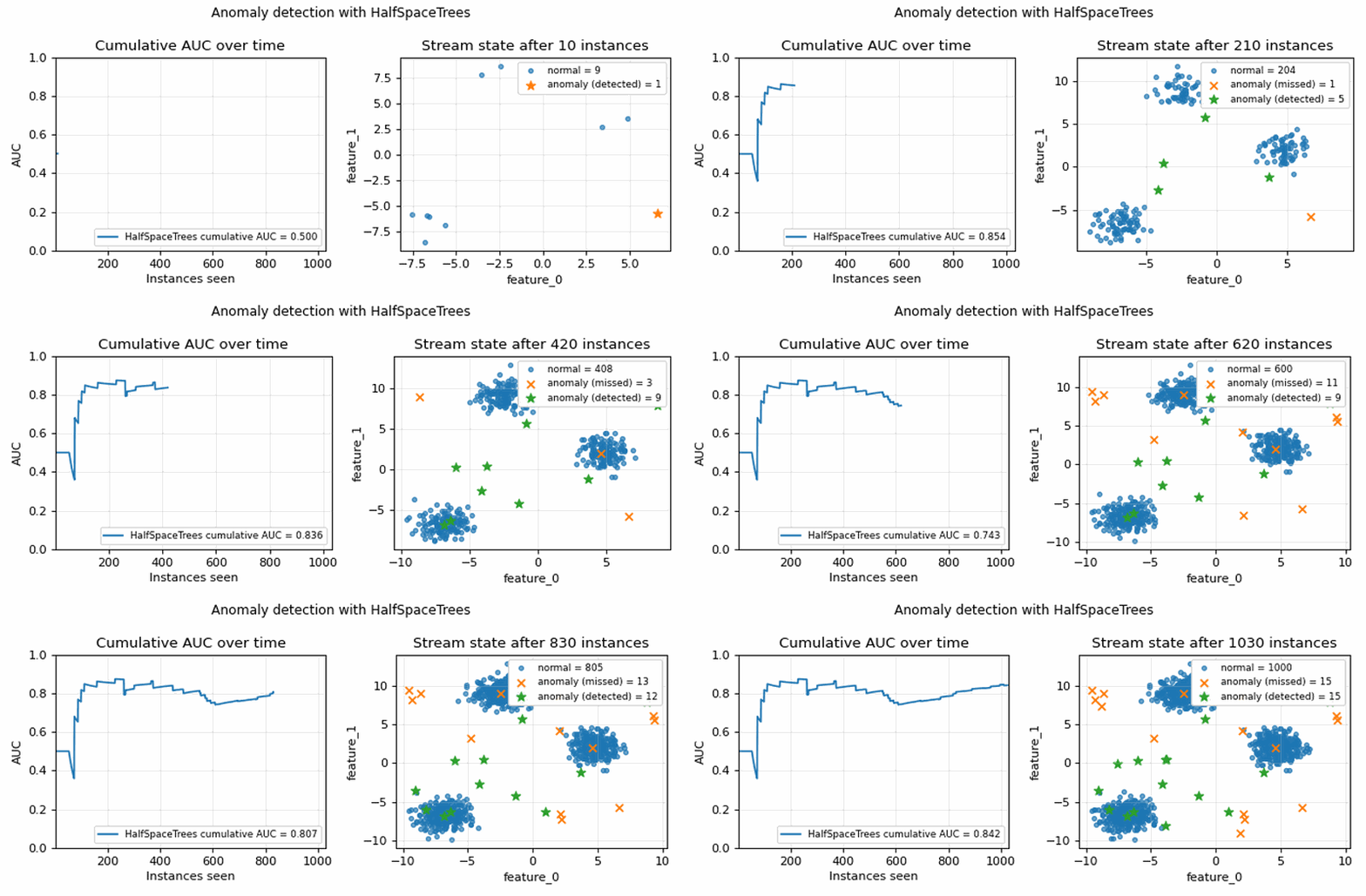 In this example, we showcase data arriving over time in an anomaly detection problem and the detector identifying (and missing others). More examples are available here.
Continual learning assumes a large problem is revealed over time through tasks (or experiences). The goal is to learn incrementally while retaining previously acquired knowledge. Unlike stream learning, past and present knowledge are equally important. The central challenge is balancing:
In this example, we showcase data arriving over time in an anomaly detection problem and the detector identifying (and missing others). More examples are available here.
Continual learning assumes a large problem is revealed over time through tasks (or experiences). The goal is to learn incrementally while retaining previously acquired knowledge. Unlike stream learning, past and present knowledge are equally important. The central challenge is balancing:
Learning Paradigms
The traditional setting (batch learning) assumes access to a fixed dataset. Models are trained offline and deployed under the assumption that the data distribution remains stable. This paradigm enables complex optimisation but does not naturally handle evolving data. Stream learning assumes data arrives sequentially and must be processed incrementally. Storing all past data is often infeasible, and models must update continuously. A key characteristic is that recent data is often more relevant, especially under changing distributions.
In this example, we showcase data arriving over time in an anomaly detection problem and the detector identifying (and missing others). More examples are available here.
Continual learning assumes a large problem is revealed over time through tasks (or experiences). The goal is to learn incrementally while retaining previously acquired knowledge. Unlike stream learning, past and present knowledge are equally important. The central challenge is balancing: - Stability: retaining past knowledge
- Plasticity: adapting to new information
- occur incrementally (no revisiting data),
- operate under memory and time constraints,
- and still retain knowledge across tasks.
Learning resources
- CapyMOA website is the best source to learn about how to apply Stream Learning and Online Continual Learning in practice, particularly the tutorials.
- Our group has prepared several tutorials, research papers and other materials over the years. Some recent examples include:
- AAAI 2026 Bridge program: Streaming Continual Learning
- LAMARR institute 2025/2026 blog series: "Learning on the flow: Stream Mining in AI Systems"
- Keynote , IEEE Big Data (9th Workshop on Stream Processing, Stream-based AI & Stream Data), Macau, 2025: “CapyMOA: Adaptive Machine Learning for Data Streams and Online Continual Learning”
-
- Tutorial , IEEE ICDE, Hong Kong, 2025: “Machine Learning on the Fly: A Hands-On Tutorial for Streaming Data”
-
- Tutorial , PRICAI, Wellington, New Zealand, 2025: “Machine Learning for Streaming Data”
- Tutorial, PAKDD, Sydney, 2025: "Practical Online Continual Learning"
- Keynote , Stream Reasoning Workshop, Politecnico di Milano, Italy, 2024: “Practical Machine Learning for Data Streams with CapyMOA”
- Tutorial , ICONIP, New Zealand, 2024: “Machine Learning for Streaming Data”
- Tutorial , PRICAI, Japan, 2024: “Machine Learning for Streaming Data”
- Tutorial , ECML-PKDD, Lithuania, 2024: “Navigating Complex Machine Learning Challenges in Streaming Data: A Hands-On Tutorial”
- Talk, Kiwi PyCon, Wellington, 2024: “Data Stream AI”
- Keynote , ACM SIGKDD (DELTA Workshop), Spain, 2024: “Practical Challenges and Insights in Concept Drift Research”
- Tutorial , ACM SIGKDD, Spain, 2024: “Practical Machine Learning for Streaming Data”
-
- Tutorial , PAKDD, Taiwan, 2024: “Machine Learning for Streaming Data”