News
Victoria University launches new cyber-security initiatives
03 May 2018 - 11:07
Staff from Victoria University of Wellington’s School of Engineering and Computer Science are in Samoa this month as part of an initiative to bring cyber-security education to the Pacific and beyond.
The group is installing 10 wireless network points to create a permanent wireless network at the National University of Samoa in Upolu, and will also advise on cyber-security.
“Having these units will open up new learning and teaching opportunities for the University,” Associate Professor Ian Welch says. But he says cyber-security education must be delivered alongside the initiative. “With their new high speed internet connection they are vulnerable to cyber-attacks, which could have devastating economic consequences.”
He and Matt Stevens, Teaching Fellow at the School of Engineering and Computer Science, will run workshops on cryptography—the process of securing online communications—and cyber-security for staff and students at the National University of Samoa.
A group led by School Manager Suzan Hall will also travel to schools in Samoa to teach students and teachers about digital technology. This initiative was first suggested by Assistant Vice-Chancellor (Pasifika) Hon. Luamanuvao Winnie Laban.
“This project will strengthen our relationship with the National University of Samoa,” says Hon. Luamanuvao Winnie Laban. “Along with the other initiatives and partnerships we have in the region, this cyber-security and digital education project is a wonderful opportunity for us to connect with our neighbours in the Pacific and play our part in helping our Pacific region to grow.”
Victoria University have also recently launched a 100-level paper in cyber-security—the first in New Zealand. This paper was developed in conjunction with CyberToa and other industry partners to fill what Associate Professor Welch refers to as a “huge skills-shortage”.
“We worked with industry to develop this paper to give students an understanding of the people, information, and processes behind cyber-security and train the people needed to fill jobs in the cyber-security industry,” says Associate Professor Welch. “We’re excited to see over 400 students studying engineering, information systems, and even a small group from law taking the paper this year, and we look forward to continuing to help our students gain these globally relevant skills.”
These two projects are part of ongoing international work and industry partnerships. Victoria University also offers cyber-security education in Fiji through its partnership with Wellington business CyberToa. Dale Carnegie, Dean of Victoria University’s School of Engineering, helped CyberToa connect with the University of the South Pacific, where they now teach four postgraduate courses.
Chris Ward, co-founder of CyberToa, says, “Our partnership with Victoria University helps us expand our business in the Pacific and improve cyber-security training in that area. In turn, Victoria University has access to some of our international connections.”
One of these international connections is with the Software Engineering Institute at Carnegie Mellon University, one of the world’s leading providers of cyber-security training. Victoria University drew on the expertise gained through this partnership to develop its 100-level paper, as well as working on several joint research projects with Carnegie Mellon.
“Through this partnership we have access to leading researchers, United States funding, and several exciting projects,” Associate Professor Welch says.
Postdoctoral Research Fellow: Anuroop Gaddam
20 Dec 2017 - 09:26
 Born in? India.
Lived in? I lived in Hyderabad, India, before moving to New Zealand in 2006. Since then I have lived in Palmerston North, Auckland and Hamilton. First job? My first job was straight after finishing my PhD. I worked as a lecturer of Electronics Engineering at the Centre for Engineering and Industrial Design at the Waikato Institute of Technology in Hamilton. Key research interests? I have broad interests within Smart Sensors, Wireless Sensor Networks, Internet of Things, Activity detection and wellness pattern generation using ad hoc Wireless Sensor Networks, e-Learning - and last but not least - educational game development. Why Wellington? Wellington is a great place to live and work, with amazing scenery. When did you begin at Vic? I started as a Postdoctoral Research Fellow in June 2017. Where can people find you at VUW? EA 107. Who have you been working with? I am working with Dr Karsten Lundqvist as a member of the e-Learning Research Group within the School of Engineering and Computer Science. What have you been working on? Creating tools to improve teaching and learning within various cultural settings, including the use of games and gaming methods in education, and especially for engaging Maori/Pasifika students in Computer Science learning. What have you enjoyed the most so far? Developing culturally-relevant games for Māori/Pasifika students who are still in school. This is because creativity is the foundation of what we do - and it is what makes creating games so exciting. Other than that, a highlight for me has been learning to speak and use Te Reo Māori for research purposes. What are some of the challenges you have faced? Coming from an Electronics Engineering background, taking up a role in Computer Science was initially a challenge – but surprisingly, what I have learnt is that when you are motivated and push yourself to try something difficult, it becomes a passion rather than a challenge. What are you looking forward to in the future? I am looking forward to using the latest technology alongside cultural diversity to advance teaching and learning. I would also like to build on my existing skills and continue my involvement in many professional associations.
A taste of future robotics
14 Dec 2017 - 09:01
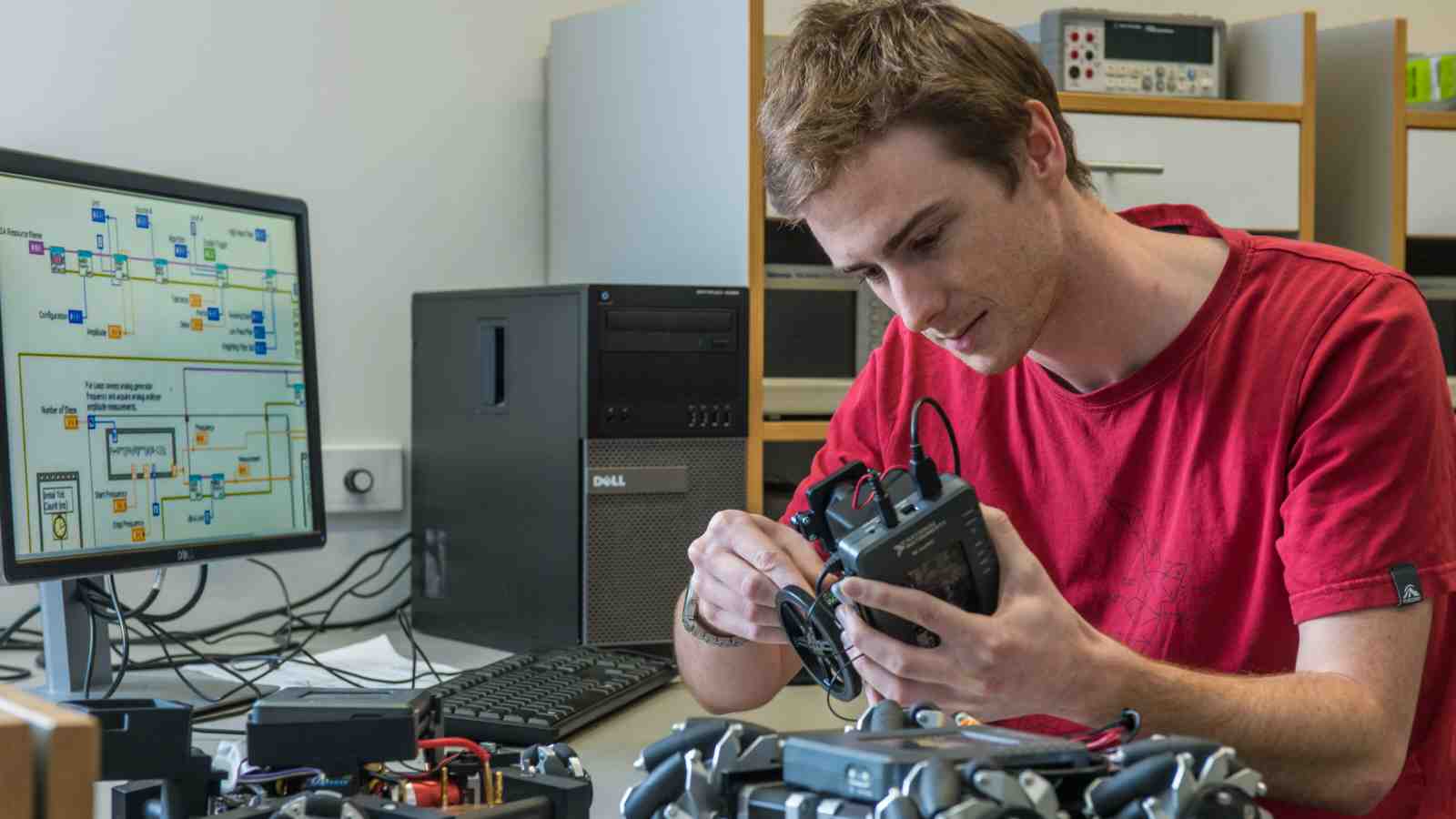 Did you know that robots can now ‘taste’ as humans do? We do now, thanks to Victoria Honours student Michael Pearson.
Michael’s ENGR 489 project gave robots the ability to mimic a human’s inquisitive nature—a nature which normally enables us to recognise objects much better than artificial systems can.
Robots are an increasingly prevalent part of our society, but they struggle to achieve some tasks which are trivial to humans, says Michael.
“Anecdotally, humans don’t just use vision to recognise objects, so why should robots?” says Michael. “My project explored how we can add more senses to a robot to improve its ability to recognise those objects too.”
In the project, which included machine learning, networking and electronics, Michael created a multi-sensory robot using a low-cost spectrometer to allow basic recognition of objects, such as a cricket ball compared to a nectarine.
Mimicking a human’s sense of taste in this way could be described as using a crude approximation of an artificial ‘mouth’, says Michael.
“When humans taste food we immediately get a sensation of how sweet, sour or perhaps bitter it is. The sensor used in this project is able to crudely detect molecules just like a human's tongue. From this information the sensor can then make a prediction as to what has been scanned.”
This classification system has varied uses, including in the self-checkout aisle of supermarkets if a customer were to weigh and scan other items to receive a cheaper price than their actual product. Michael’s robot can tell a carrot from a cucumber, for example.
Did you know that robots can now ‘taste’ as humans do? We do now, thanks to Victoria Honours student Michael Pearson.
Michael’s ENGR 489 project gave robots the ability to mimic a human’s inquisitive nature—a nature which normally enables us to recognise objects much better than artificial systems can.
Robots are an increasingly prevalent part of our society, but they struggle to achieve some tasks which are trivial to humans, says Michael.
“Anecdotally, humans don’t just use vision to recognise objects, so why should robots?” says Michael. “My project explored how we can add more senses to a robot to improve its ability to recognise those objects too.”
In the project, which included machine learning, networking and electronics, Michael created a multi-sensory robot using a low-cost spectrometer to allow basic recognition of objects, such as a cricket ball compared to a nectarine.
Mimicking a human’s sense of taste in this way could be described as using a crude approximation of an artificial ‘mouth’, says Michael.
“When humans taste food we immediately get a sensation of how sweet, sour or perhaps bitter it is. The sensor used in this project is able to crudely detect molecules just like a human's tongue. From this information the sensor can then make a prediction as to what has been scanned.”
This classification system has varied uses, including in the self-checkout aisle of supermarkets if a customer were to weigh and scan other items to receive a cheaper price than their actual product. Michael’s robot can tell a carrot from a cucumber, for example.The end goal of the project was to improve the accuracy of existing classification systems, says Michael. He used a lot of the knowledge he gained studying at Victoria, especially his 400-level Artificial Intelligence papers, which gave him the understanding of the algorithms necessary for the project. However, it turned out to be a challenge. “Often there was a lot of learning required before progress could be made.”
The facilities provided by the University were also invaluable, from the software Michael used while studying, to the hardware to run his experiments. He also has some advice for future students: “Make sure you don’t forget to document all of the small decisions that seem obvious to you. Every aspect of your project is important—and the more you can communicate what you did, the happier you’ll be with your final report.” Being in Wellington also means Michael is close to several high-profile technology companies, including TradeMe and Xero, which could now feature in his future. “I’d love to work on embedded systems, with some aspect of machine learning,” he says. “This project has given me so many skills that I hope to use in my future, both personally and professionally.”
Senior Lecturer: Introducing Alvin Valera to ECS
12 Dec 2017 - 09:24
 Name? Alvin Valera.
Born in? The Philippines.
Lived in? First 24 years in the Philippines and the rest (up until November) in Singapore.
Position at VUW? Senior Lecturer.
Key research interests? Internet of Things (IoT), wireless ad hoc and sensor networks.
Most looking forward to at VUW? Working with students to design and build novel IoT systems.
Where can people find you at VUW? AM 401.
Why Wellington? When I visited Wellington two years back, I was mesmerised by its beautiful harbour.
Favourite movie? Star Wars (Return of the Jedi).
Favourite music? Sailing by Christopher Cross
Favourite food? Lechon - Philippine-style roast pork.
Quote to live by? “A person who never made a mistake never tried anything new.”
Name? Alvin Valera.
Born in? The Philippines.
Lived in? First 24 years in the Philippines and the rest (up until November) in Singapore.
Position at VUW? Senior Lecturer.
Key research interests? Internet of Things (IoT), wireless ad hoc and sensor networks.
Most looking forward to at VUW? Working with students to design and build novel IoT systems.
Where can people find you at VUW? AM 401.
Why Wellington? When I visited Wellington two years back, I was mesmerised by its beautiful harbour.
Favourite movie? Star Wars (Return of the Jedi).
Favourite music? Sailing by Christopher Cross
Favourite food? Lechon - Philippine-style roast pork.
Quote to live by? “A person who never made a mistake never tried anything new.”
Student’s smoking hot idea adds fire to DJ scene
07 Dec 2017 - 09:06
 A Computer Graphics student has created a fully interactive tool for DJs and artists where a digital smoke simulation reacts to music in real-time.
Jack Purvis’s Honours project looked at the challenge of simulating smoke using computer graphics techniques, and how the effect can be influenced by a dynamic input like music to create an appealing visualisation.
Jack came up with the project himself, combining his passions for computer graphics and music.
“I had built music visualisers in the past, but I wanted a deeper understanding of how audio processing works,” explains Jack. “I designed a program which reads audio from an input device, allowing a livestream of music to be visualised.”
Jack also wanted to learn more about the computer graphics techniques that enable smoke simulation. Fluid dynamics and its associated mathematics can be used to simulate the physical properties of real-world fluids. As smoke is often used as a practical effect in live performances it served as a good candidate for application in a music visualisation.
Properties of music such as the volume level, beats and frequency information can be used to influence the smoke effect to produce a visualisation. The smoke simulation implementation is based on the Navier-Stokes equations, which describe the motion of fluids—like smoke—over time.
“Implementing the smoke simulation showed that I can use my passions to motivate myself to solving a complex engineering problem,” says Jack. “People really enjoyed watching the visualisation, so I received a lot of positive feedback on the final output.”
The tool is ideal for use on screens in clubs or at gigs, or to create music videos.
Jack’s supervisor, Professor Neil Dodgson, helped him design the project and supported him along the way with tips on mathematics, as well as presentation and technical writing skills.
Jack also credits his university courses with providing him with the skills to complete the project, not least the ability to self-manage and implement a large project independently.
“From the Computer Science and Engineering side, I learnt how to solve complex problems by breaking them down into smaller, logical steps,” he says. “From the Design side, I was able to apply my design thinking to create an appealing visual effect that engages the audience.”
Jack’s dream job would to be to combine his skills in computer science and design to build audio-visual experiences for live performance or exhibitions. For now he loves living in Wellington and being a Victoria student where he is exposed to new fields of research and connections with the industry.
“Victoria has many leading researchers who are exploring exciting new technologies,” Jack says. “If you are passionate about a certain topic you can propose your own project idea. A project that is tailored to your own interests is highly motivating and can lead to a highly successful Honours year.”
A Computer Graphics student has created a fully interactive tool for DJs and artists where a digital smoke simulation reacts to music in real-time.
Jack Purvis’s Honours project looked at the challenge of simulating smoke using computer graphics techniques, and how the effect can be influenced by a dynamic input like music to create an appealing visualisation.
Jack came up with the project himself, combining his passions for computer graphics and music.
“I had built music visualisers in the past, but I wanted a deeper understanding of how audio processing works,” explains Jack. “I designed a program which reads audio from an input device, allowing a livestream of music to be visualised.”
Jack also wanted to learn more about the computer graphics techniques that enable smoke simulation. Fluid dynamics and its associated mathematics can be used to simulate the physical properties of real-world fluids. As smoke is often used as a practical effect in live performances it served as a good candidate for application in a music visualisation.
Properties of music such as the volume level, beats and frequency information can be used to influence the smoke effect to produce a visualisation. The smoke simulation implementation is based on the Navier-Stokes equations, which describe the motion of fluids—like smoke—over time.
“Implementing the smoke simulation showed that I can use my passions to motivate myself to solving a complex engineering problem,” says Jack. “People really enjoyed watching the visualisation, so I received a lot of positive feedback on the final output.”
The tool is ideal for use on screens in clubs or at gigs, or to create music videos.
Jack’s supervisor, Professor Neil Dodgson, helped him design the project and supported him along the way with tips on mathematics, as well as presentation and technical writing skills.
Jack also credits his university courses with providing him with the skills to complete the project, not least the ability to self-manage and implement a large project independently.
“From the Computer Science and Engineering side, I learnt how to solve complex problems by breaking them down into smaller, logical steps,” he says. “From the Design side, I was able to apply my design thinking to create an appealing visual effect that engages the audience.”
Jack’s dream job would to be to combine his skills in computer science and design to build audio-visual experiences for live performance or exhibitions. For now he loves living in Wellington and being a Victoria student where he is exposed to new fields of research and connections with the industry.
“Victoria has many leading researchers who are exploring exciting new technologies,” Jack says. “If you are passionate about a certain topic you can propose your own project idea. A project that is tailored to your own interests is highly motivating and can lead to a highly successful Honours year.”
Teaching Fellow: Introducing Saeed Mirghasemi to ECS
05 Dec 2017 - 10:01
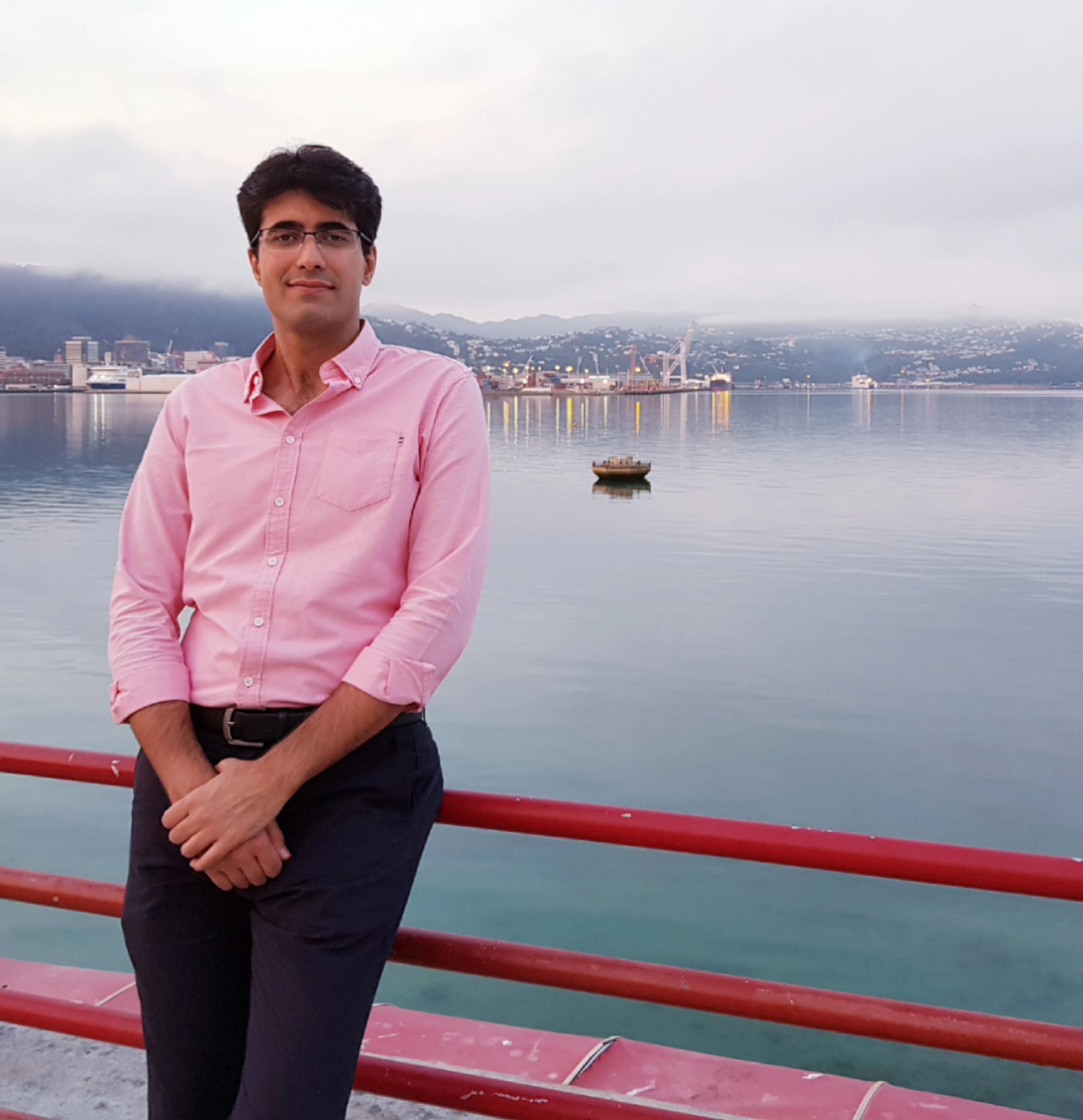 Name? Saeed Mirghasemi.
Born in? Tehran, Iran.
Lived in? Iran and NZ.
First job? Electronic designer.
Position at VUW? Teaching Fellow.
Key research interests? Computer vision - Data analysis.
Most looking forward to at VUW? Teaching a lot and learning a lot.
Where can people find you at VUW? My office! EA 108.
Why Wellington? It was an accident, but I am glad I ended up here.
Favourite movie? There is no such a thing as a single favourite movie, but I like Fight Club very much.
Favourite music? Persian traditional. Get a glimpse of it: https://www.youtube.com/watch?v=c9zy_eureGs
Favourite food? Mirza Ghasemi. See the recipe: https://www.youtube.com/watch?v=XQzx0XLr2ps
Affirmation to live by? “Education is the most powerful weapon which you can use to change the world” (Nelson Mandela).
Name? Saeed Mirghasemi.
Born in? Tehran, Iran.
Lived in? Iran and NZ.
First job? Electronic designer.
Position at VUW? Teaching Fellow.
Key research interests? Computer vision - Data analysis.
Most looking forward to at VUW? Teaching a lot and learning a lot.
Where can people find you at VUW? My office! EA 108.
Why Wellington? It was an accident, but I am glad I ended up here.
Favourite movie? There is no such a thing as a single favourite movie, but I like Fight Club very much.
Favourite music? Persian traditional. Get a glimpse of it: https://www.youtube.com/watch?v=c9zy_eureGs
Favourite food? Mirza Ghasemi. See the recipe: https://www.youtube.com/watch?v=XQzx0XLr2ps
Affirmation to live by? “Education is the most powerful weapon which you can use to change the world” (Nelson Mandela).
Learning to programme: To touch or not to touch?
30 Nov 2017 - 09:43
 A Computer Science student has explored the potential of using interactive touch tables to teach programming compared to traditional mouse and keyboard versions, fulfilling a long-held aspiration to investigate how people learn best.
Master’s student Ben Selwyn-Smith, who cites a keen interest in education, found that the benefits of the new approach include the ability for multiple users to code at the same time, something which was previously impossible.
For these purposes, a visual, block-based programming language called Tabletop Grace was used, an extension from an existing mouse and keyboard block language called Tiled Grace. Block-based languages, including one called Scratch, have previously been used to teach children how to code, as they provide an easy way to create games and animations with no syntax errors.
“The main motivation behind this project was to combine block-based programming with pair programming, where two people can code at the same time, and also with interactive touch tables,” explains Ben. “Research has shown that each of these is individually worthwhile, but combinations of all three did not exist.”
Previously, pair programming with block languages was typically done either with two individuals sharing one single-user device, or two devices with remote collaboration, whereas using an interactive touch table allows users to collaborate from the same location.
“This project is great in that I got to combine software development and design with research, including experience in conducting that research, formal presentations and software demonstrations,” Ben continues. “I now feel much more prepared for future endeavours—if I decide to pursue a career in programming or research I have a good grounding in both.”
Ben also enjoyed working with his two supervisors from Victoria’s School of Engineering and Computer Science: Dr Craig Anslow, with his extensive knowledge of interactive touch tables, and Dr Michael Homer, the creator of Tiled Grace, the block-based language that formed the basis of Ben’s new software, Tabletop Grace.
“Getting to work alongside my supervisors was great, as well as being a collaborator on a paper that was accepted by the Blocks and Beyond 2017 Workshop,” says Ben. “Tabletop Grace was considered to be as usable as Tiled Grace, so the transition to touch tables was successful. Also, 70 percent of participants in my user study said they preferred working on the tabletop, as it was less frustrating and more enjoyable, intuitive and novel.”
Ben credits Victoria’s 24-hour access computer labs with keeping him on task during the project.
“The coolest thing about being an student at Victoria is that if I feel like coming in and doing some work at 4am, I can!” he says. “Also living in Wellington, everything I need is within easy walking distance, which keeps me healthy despite long hours working at a computer.”
“As I did a second major in Japanese at undergraduate level, my dream job would be somewhere where I can combine my language skills with computer science, either here or in Japan.”
A Computer Science student has explored the potential of using interactive touch tables to teach programming compared to traditional mouse and keyboard versions, fulfilling a long-held aspiration to investigate how people learn best.
Master’s student Ben Selwyn-Smith, who cites a keen interest in education, found that the benefits of the new approach include the ability for multiple users to code at the same time, something which was previously impossible.
For these purposes, a visual, block-based programming language called Tabletop Grace was used, an extension from an existing mouse and keyboard block language called Tiled Grace. Block-based languages, including one called Scratch, have previously been used to teach children how to code, as they provide an easy way to create games and animations with no syntax errors.
“The main motivation behind this project was to combine block-based programming with pair programming, where two people can code at the same time, and also with interactive touch tables,” explains Ben. “Research has shown that each of these is individually worthwhile, but combinations of all three did not exist.”
Previously, pair programming with block languages was typically done either with two individuals sharing one single-user device, or two devices with remote collaboration, whereas using an interactive touch table allows users to collaborate from the same location.
“This project is great in that I got to combine software development and design with research, including experience in conducting that research, formal presentations and software demonstrations,” Ben continues. “I now feel much more prepared for future endeavours—if I decide to pursue a career in programming or research I have a good grounding in both.”
Ben also enjoyed working with his two supervisors from Victoria’s School of Engineering and Computer Science: Dr Craig Anslow, with his extensive knowledge of interactive touch tables, and Dr Michael Homer, the creator of Tiled Grace, the block-based language that formed the basis of Ben’s new software, Tabletop Grace.
“Getting to work alongside my supervisors was great, as well as being a collaborator on a paper that was accepted by the Blocks and Beyond 2017 Workshop,” says Ben. “Tabletop Grace was considered to be as usable as Tiled Grace, so the transition to touch tables was successful. Also, 70 percent of participants in my user study said they preferred working on the tabletop, as it was less frustrating and more enjoyable, intuitive and novel.”
Ben credits Victoria’s 24-hour access computer labs with keeping him on task during the project.
“The coolest thing about being an student at Victoria is that if I feel like coming in and doing some work at 4am, I can!” he says. “Also living in Wellington, everything I need is within easy walking distance, which keeps me healthy despite long hours working at a computer.”
“As I did a second major in Japanese at undergraduate level, my dream job would be somewhere where I can combine my language skills with computer science, either here or in Japan.”
Conference success leads to valuable connections for Victoria
29 Nov 2017 - 09:04
 Victoria’s Evolutionary Computation Research Group (ECRG), based in the School of Engineering and Computer Science, put on a strong performance at the annual International Conference on Simulated Evolution and Learning (SEAL 2017).
The conference, held at China’s Southern University of Science and Technology (SUSTech) this month, represented an opportunity for Victoria researchers to connect and collaborate with their counterparts from around the world.
Postdoctoral fellow Dr Harith Al-Sahaf and staff members Professor Mengjie Zhang and Dr Bing Xue won the overall Best Paper Award for their contribution on the topic of genetic programming, particularly texture image classification.
“Winning this award shows that the work done at Victoria by the ECRG is new, well-recognised by experts in Evolutionary Computation, and has made a valuable contribution to the field,” says Dr Al-Sahaf.
The first workshop on Evolutionary Optimisation and Learning, held jointly between SUSTech and Victoria, was also successful, with more than 100 conference attendees taking part. Professor Zhang provided an overview of Victoria’s ECRG/Artificial Intelligence (AI) groups, while group members gave presentations on five strategic directions and related research.
During the conference, five ECRG group members each chaired a session in their strength, while Professor Zhang chaired several keynote speeches and tutorials.
“Many people came to talk to us about collaborating on research, or taking up a PhD or postdoctoral position with us, further enhancing Victoria’s reputation,” says Professor Zhang. “Several staff members also established new research collaborations and contacts which are extremely valuable to the University.”
Dr Al-Sahaf also notes the importance of networking to the research field, including attracting funding to explore new research avenues, and collaborating with industry partners to solve real-life problems.
“Networking is a very important factor that allows researchers to share ideas and engage in deeper discussions with authors from around the globe. Having external collaborations shows the exemplary quality of research at Victoria, and allows us to benefit from the experience of other researchers.”
After the conference, group members visited Shenzhen University to seek further collaborations.
Professor Zhang is now in Hanoi to give a keynote speech for IES 2017: The 21st Asia Pacific Symposium on Intelligent and Evolutionary Systems. While in Hanoi he will also visit the Dean and President of Le Quy Don Technical University to discuss research collaborations in AI and security.
Staff from Le Quy Don visited Victoria last year, and will send a student to take a Master’s at the School of Engineering and Computer Science, as well as one or two staff members to do a PhD in AI and security using a Vietnamese Government Scholarship.
Victoria’s Evolutionary Computation Research Group (ECRG), based in the School of Engineering and Computer Science, put on a strong performance at the annual International Conference on Simulated Evolution and Learning (SEAL 2017).
The conference, held at China’s Southern University of Science and Technology (SUSTech) this month, represented an opportunity for Victoria researchers to connect and collaborate with their counterparts from around the world.
Postdoctoral fellow Dr Harith Al-Sahaf and staff members Professor Mengjie Zhang and Dr Bing Xue won the overall Best Paper Award for their contribution on the topic of genetic programming, particularly texture image classification.
“Winning this award shows that the work done at Victoria by the ECRG is new, well-recognised by experts in Evolutionary Computation, and has made a valuable contribution to the field,” says Dr Al-Sahaf.
The first workshop on Evolutionary Optimisation and Learning, held jointly between SUSTech and Victoria, was also successful, with more than 100 conference attendees taking part. Professor Zhang provided an overview of Victoria’s ECRG/Artificial Intelligence (AI) groups, while group members gave presentations on five strategic directions and related research.
During the conference, five ECRG group members each chaired a session in their strength, while Professor Zhang chaired several keynote speeches and tutorials.
“Many people came to talk to us about collaborating on research, or taking up a PhD or postdoctoral position with us, further enhancing Victoria’s reputation,” says Professor Zhang. “Several staff members also established new research collaborations and contacts which are extremely valuable to the University.”
Dr Al-Sahaf also notes the importance of networking to the research field, including attracting funding to explore new research avenues, and collaborating with industry partners to solve real-life problems.
“Networking is a very important factor that allows researchers to share ideas and engage in deeper discussions with authors from around the globe. Having external collaborations shows the exemplary quality of research at Victoria, and allows us to benefit from the experience of other researchers.”
After the conference, group members visited Shenzhen University to seek further collaborations.
Professor Zhang is now in Hanoi to give a keynote speech for IES 2017: The 21st Asia Pacific Symposium on Intelligent and Evolutionary Systems. While in Hanoi he will also visit the Dean and President of Le Quy Don Technical University to discuss research collaborations in AI and security.
Staff from Le Quy Don visited Victoria last year, and will send a student to take a Master’s at the School of Engineering and Computer Science, as well as one or two staff members to do a PhD in AI and security using a Vietnamese Government Scholarship.
A buzz about high tech hives
28 Nov 2017 - 09:24
 An enterprising Network Engineering student spent his Honours year designing a new way to help beekeepers monitor their hives from a distance.
Reuben Puketapu’s ENGR 489 project, titled Internet-connected beehives, addresses the problems faced by beekeepers with beehives in remote locations, fulfilling his long-term goal to use technology to “make people’s lives easier”.
An enterprising Network Engineering student spent his Honours year designing a new way to help beekeepers monitor their hives from a distance.
Reuben Puketapu’s ENGR 489 project, titled Internet-connected beehives, addresses the problems faced by beekeepers with beehives in remote locations, fulfilling his long-term goal to use technology to “make people’s lives easier”.There is currently a lack of resources to help beekeepers know when their hives require attention, says Reuben, as well as a recent spate of thefts throughout New Zealand that have robbed beekeepers of hard-earned revenue. Honey from hives is one of New Zealand’s main agricultural exports, with over 700,000 registered beehives. Reuben ‘smart’ beehive solution has internet connectivity and uses sensors to monitor key metrics for the beekeepers. These metrics include tracking colony activity and swarm health, and providing real-time alerts for threats to the hive. “I wanted to create an entire system to solve the problems that beekeepers are currently facing,” Reuben says. “Because there are so many elements to the system, making everything work in harmony was a challenge. I used all the skills I learnt through my university courses, from Arduino programming in first year to cloud computing in fourth year.”
Reuben used Amazon Web Services (AWS) to make a cloud database and a web application for accessing beehive metrics through a simple interface, supported by AWS Advanced Consulting Partner, API Talent.
He says that he wanted to create something using both the ‘Internet of Things’, where objects are connected to the internet, as well as the ‘cloud’ where the data is stored, as both are cutting-edge technologies. “I’ve loved the whole experience of this project, especially working with API Talent and learning about AWS which is a massive game-changer at the moment,” says Reuben. “Learning from the best in the industry really made me understand what it takes to be an engineer. It’s awesome to have experience of the process involved in designing, implementing and evaluating a solution to a real-life problem. “This experience has inspired me to keep expanding my knowledge, and I’m excited for what’s to come in the technology field.”
A summer to remember: Welcoming our ECS Summer Scholars
14 Nov 2017 - 09:48

Survey & Interviews of Recent ECS Graduates
Chelsea Miller
Pilot Contamination in 5G Massive MIMO Systems
Benjamin Evans
Evolutionary Machine Learning and Data Mining
Ryan Curry
Study of Industrial IoT applications and use cases in NZ
Mansour Javaher
QoS-aware Web Service Location Allocation
Tao Shi
QoS-aware Web Service Location Allocation
Kathleen Griffin
Automated training of orchestral conducting
Daniel Forbes
Validating Fitbits
Shaun Swan
Microfluidic testbed for plasmonic sensors
Samuel Devese
Lead-free ferroelectrics for tunable capacitors, acoustic transducers and data storage
Benjamin Selwyn-Smith
Virtual Reality Simulation for Healthcare Education
Jordan MacLachlan
Evolutionary machine learning for dynamic vehicle routing problem
Luke Johnson
Evolutionary Feature Selection and Dimensionality Reduction for Large-Scale Classification
Ching Ke
Physiological signal processing
Ikram Singh
Electrical Standards MSL Software and Measurement Systems
Hamish Gibb
Electrical Standards MSL Software and Measurement Systems
Aran Warren
Developing a Motion Sensor
Julian Schurhammer
An automated ambulance critical inventory tracking and alerting system
Janice Chin
Harmonic Scale Development
Dipenenkumar Patel
Analytics Harbour Development
Jonathan Carr
TrafficVis: Visualizing Network Traffic Resilience
Daniel Braithwaite
Transport Network Resilience Proof of Concept
Li Li
Transport Network Resilience Proof of Concept
James Miller
Real time video stitching for live 360 video VR streaming
This topic: Main > NewsArchive
Topic revision: 23 Mar 2026, christo
Topic revision: 23 Mar 2026, christo